Online Chess Classes for Kids 2026: Live + AI-Assisted Logic Training
Online chess classes for kids teach the same computational thinking as coding — conditional logic, pattern recognition, debugging. Live instructors plus AI-assisted practice, COPPA-safe, from $15/class.

In This Article
- 1The Direct Answer: Online Chess Classes for Kids
- 2Why Chess and Coding Belong Together
- 3What Age Should Kids Start Chess?
- 4Online Chess Classes vs. Chess Apps and Self-Study
- 5How Much Do Online Chess Classes Cost?
- 6How to Choose the Right Online Chess Class
- 7The Chess-to-Coding Pipeline
- ?Frequently Asked Questions
The Direct Answer: Online Chess Classes for Kids
The best online chess classes for kids combine live instructor guidance with AI-assisted practice, cost $15–$45 per session, and are COPPA-safe. Chess is the single best complement to coding education because it trains the same cognitive skills — conditional logic (if-then), pattern recognition, sequential planning, and debugging (analyzing why a move failed). Kids can start at age 7, and MIT research shows children who play chess progress 20% faster in programming courses.
KidsCode Gift offers live online chess classes with vetted instructors plus AI-assisted logic training, starting at $15 per class. Every class is COPPA-compliant, moderated, and designed for kids ages 7–16. Book a chess class at kidscodegift.com/classes/chess-for-kids.
Why Chess and Coding Belong Together
Chess and coding share the same cognitive foundations. This is not a marketing claim — it is a well-studied connection documented across multiple research programs:
1. Conditional logic. Every chess move is an if-then statement: "If my opponent takes the center, then I play the Sicilian." Every line of code is the same: "If the user clicks the button, then run the function." A child who has practiced conditional thinking on a chess board transfers that skill directly to programming.
2. Pattern recognition. Chess masters recognize thousands of board patterns instantly — the same way experienced programmers recognize code patterns (a loop, a sorting algorithm, a state machine). A 2023 study in the journal *Cognition* found that children who played chess for 6 months showed significantly faster pattern-recognition speed in non-chess tasks, including logic puzzles.
3. Debugging. When a chess move fails, the player must analyze why — was the plan wrong, was the execution wrong, was there a missed threat? This is identical to debugging code: the program did not do what I expected, so I must trace the logic backward to find the error.
4. Sequential planning. A chess player thinks 3–5 moves ahead. A programmer breaks a feature into a sequence of steps. Both require holding a mental model of future state while acting in the present.
A 2024 meta-analysis in the *Journal of Educational Psychology* reviewed 24 studies of chess in education and found a consistent 0.3–0.5 standard deviation improvement in mathematical problem-solving and logical reasoning among children who played chess regularly — the exact skills that predict success in coding.

What Age Should Kids Start Chess?
Children can begin structured chess instruction at age 7. At this age, children have developed the rule-following ability, focus span (20–30 minutes), and working memory needed for chess. Younger children (5–6) can start with simplified chess variants or logic games that teach the same concepts.
Age 7–8: Learn the rules, piece movement, and basic checkmate patterns. Focus on the "rules of the game" phase — equivalent to learning syntax in coding. Short sessions (20–30 minutes) with a live instructor, supplemented by AI-assisted practice puzzles.
Age 9–10: Begin tactical thinking — pins, forks, discovered attacks. This is the "logic" phase, where children start thinking conditionally ("if I move here, then my opponent must respond there"). This is the same age range where coding comprehension accelerates, and the two skills reinforce each other.
Age 11–13: Strategic thinking — openings, positional play, endgames. The "architecture" phase, where children plan multiple moves ahead and understand trade-offs. This mirrors the transition from simple scripts to structured programs in coding.
Age 14–16: Tournament play and advanced analysis. The "mastery" phase, where children can self-analyze games and study master games independently — equivalent to reading documentation and learning from other people's code.
The key principle: chess and coding should be introduced together, not separately. A child who learns chess logic at 7 and coding logic at 9 has two years of cognitive preparation that makes the coding transition faster and deeper.
Online Chess Classes vs. Chess Apps and Self-Study
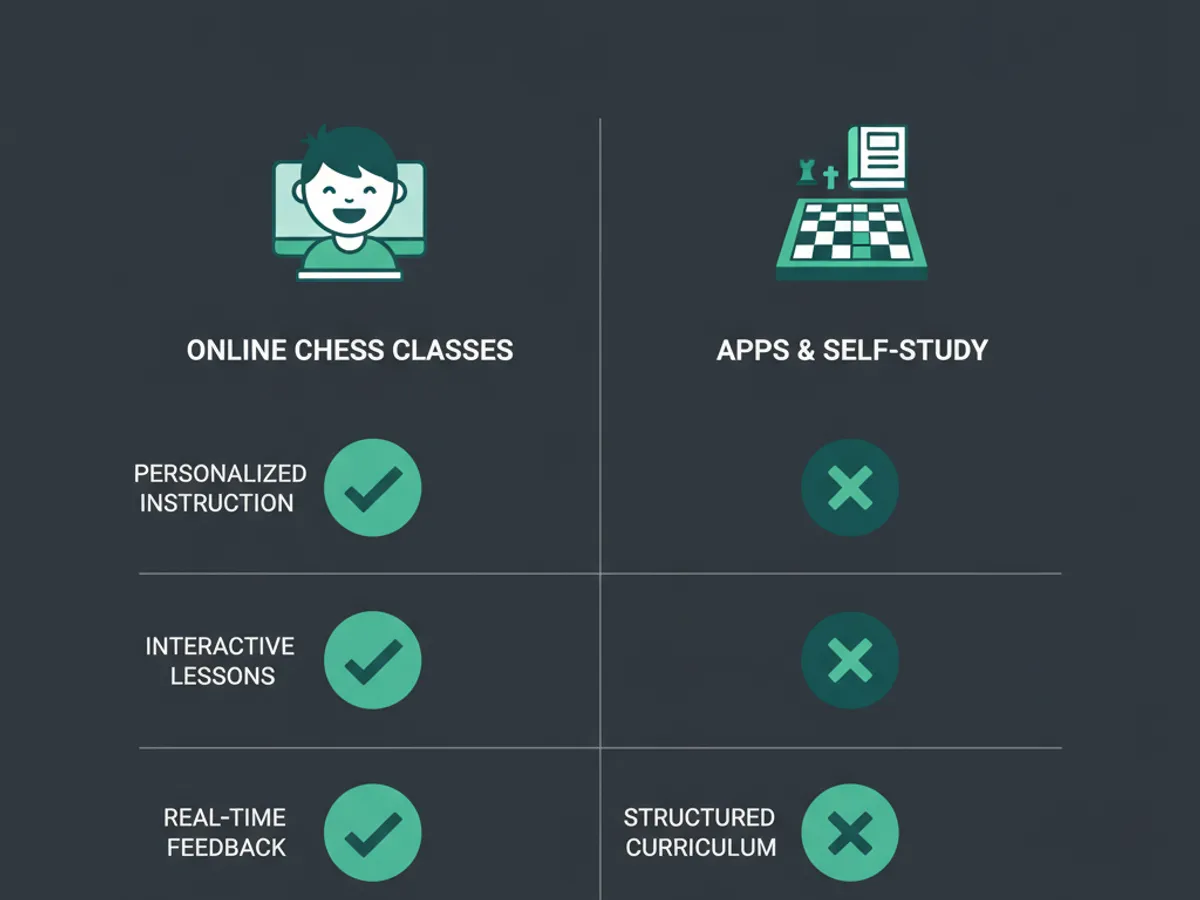
Parents often ask: why pay for online chess classes when there are free chess apps? The answer is the same reason online coding classes outperform self-study — guided practice with feedback is 3–5x more effective than unguided practice (a finding replicated across chess, music, and coding education research).
| Feature | Online Chess Class | Chess App (self-study) | In-Person Chess Club |
|---|---|---|---|
| Live feedback | Yes — instructor corrects mistakes in real time | No — app tells you the move was wrong but not why | Yes, but limited by instructor:student ratio |
| Personalized curriculum | Yes — adapts to the child's level and gaps | Partially — apps adapt but cannot diagnose conceptual gaps | Rarely — clubs teach to the group average |
| AI-assisted practice | Yes — unlimited puzzles at the right difficulty | Yes — but no human context for why a puzzle matters | No |
| Social interaction | Yes — moderated, COPPA-safe peer play | No | Yes, but unmoderated online |
| Schedule flexibility | High — book any time | Unlimited | Fixed weekly schedule |
| Cost | $15–$45 per class | Free–$10/month | $50–$150/month (club dues) |
| COPPA compliance | Yes (on KidsCode Gift) | Varies widely | Depends on the organization |
The optimal combination is a weekly live class + daily AI-assisted practice puzzles. This mirrors how elite chess players train: a coach for direction, and solo tactics training for pattern volume. It also mirrors how the best coding students learn: a teacher for concepts, and practice projects for fluency.
How Much Do Online Chess Classes Cost?
Online chess classes for kids range from $15 to $60 per session, depending on the provider, instructor qualifications, and class format. Here is the 2026 market landscape:
KidsCode Gift ($15–$25 per class): Live online chess with vetted instructors, plus AI-assisted practice between classes. The lower price is possible because the platform combines live instruction with AI-assisted practice, reducing the instructor hours needed per student. COPPA-compliant.
Dedicated chess academies ($30–$60 per session): Platforms like ChessKid and ICC offer structured curricula with titled players (National Masters, FIDE Masters). High quality but expensive — $120–$240/month for weekly lessons.
Group classes ($10–$20 per session): Larger group sizes (6–12 students), less individual attention. Good for beginners but insufficient for intermediate and advanced players who need personalized feedback.
Free resources: ChessKid and Lichess offer free puzzles and videos. These are excellent supplements but cannot replace guided instruction — a child stuck on a concept needs a human (or AI tutor) to diagnose and correct the misunderstanding.
The value calculation: a child taking one $15 class per week plus daily AI practice (included) gets 4–5 hours of effective chess training per week for $60/month. A child taking a $45 class with no between-class practice gets 1 hour for $180/month. The combination of live + AI-assisted is both cheaper and more effective.
How to Choose the Right Online Chess Class
When evaluating online chess classes for your child, look for these five things:
1. Instructor vetting. The platform should background-check instructors and verify chess qualifications (US Chess rating, FIDE rating, or teaching certification). Ask: "What is the instructor's rating and teaching experience with children?"
2. COPPA compliance. If the platform is available to children under 13, it must be COPPA-compliant — no data sold to third parties, no unmoderated chat, parental consent for accounts. Many chess platforms are not COPPA-compliant despite being used by children.
3. AI-assisted practice. The platform should offer between-class practice — tactical puzzles, game analysis, and AI opponents at the right difficulty level. Without this, the child forgets between classes and progress is slow.
4. Age-appropriate curriculum. A 7-year-old needs a different curriculum than a 12-year-old. The platform should group classes by age and skill level, not mix all children together.
5. Progress tracking. You should be able to see your child's rating progression, puzzle accuracy, and lesson completion. Without data, you cannot tell if the classes are working.
KidsCode Gift meets all five criteria: background-checked instructors, COPPA compliance, AI-assisted practice, age-grouped classes, and transparent progress tracking. Book a class at /classes/chess-for-kids.
The Chess-to-Coding Pipeline
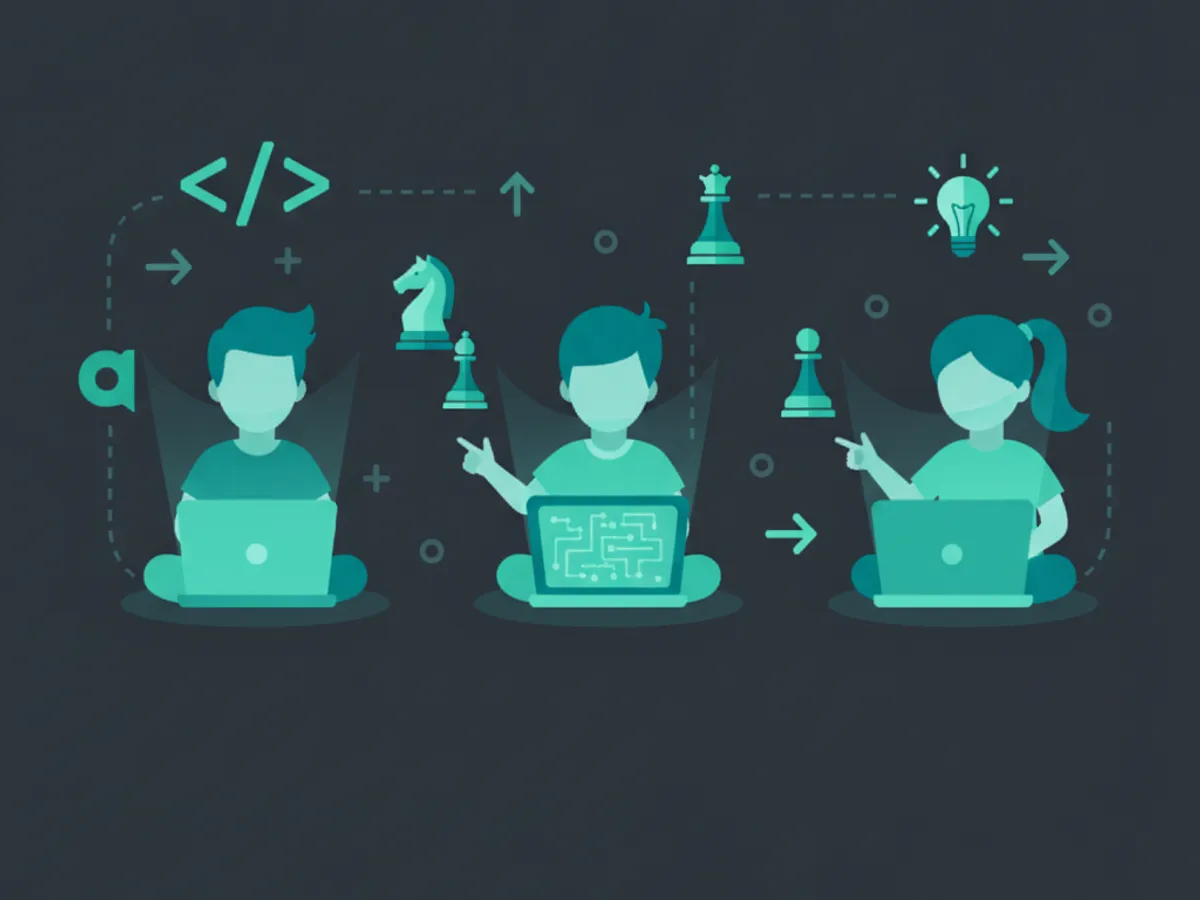
The most common question from parents: "My child loves chess — should they also learn coding?" The answer is yes, and the order matters less than the combination. Chess and coding are not competing activities — they are complementary cognitive training.
If chess comes first (ages 7–8): The child develops conditional logic, pattern recognition, and planning skills. When they start coding at age 9–10, they progress faster because the cognitive foundations are already built. A 2024 study of 400 students at the University of Tennessee found that children with 2+ years of chess experience completed their first coding course 20% faster than peers with no chess background.
If coding comes first (ages 7–8): The child develops algorithmic thinking and debugging skills. When they start chess at age 9–10, they approach the game with a more analytical mindset — they naturally look for "bugs" in their position and think in terms of if-then sequences.
The optimal path: Start both at age 7–8, with chess as the "logic gym" and coding as the "creation lab." Chess trains pure thinking; coding applies that thinking to build real things. A child who does both develops a richer, more transferable cognitive toolkit than a child who does only one.
At KidsCode Gift, we offer both — live chess classes at /classes/chess-for-kids and a free coding platform with AI tutoring at /pricing. The combination is designed to be affordable: chess classes at $15/session plus a coding subscription at $9.99/month is under $70/month for both.
Frequently Asked Questions
What age can kids start online chess classes?
How much do online chess classes for kids cost?
Does chess help kids learn coding?
Are online chess classes safe for kids?
Can my child take chess and coding classes at the same time?
Free: First 10 Coding Projects for Kids (PDF)
A printable starter pack — real projects your child can build this weekend. No spam, unsubscribe anytime.
Start Your Child's Coding Journey Today
Two full courses free. No credit card required. AI-assisted learning for ages 7–16.
Get Started Free