Coding for 12-Year-Olds: The 2026 Guide to Middle School Coding and Beyond
Age 12 is the middle school coding launch — the year coding starts counting toward portfolios, certificates, and even school applications. Here is the complete 2026 guide to languages, projects, admissions advantages, and pricing.
In This Article
- 1What Should a 12-Year-Old Learn First in Coding?
- 2Why Age 12 Is the Middle School Coding Launch
- 3The Best Languages for 12-Year-Olds
- 4What a 12-Year-Old Can Build, Month by Month
- 5How Coding Helps With School Applications and Portfolios
- 6A 4-Week Starter Plan and Honest Pricing
- ?Frequently Asked Questions
What Should a 12-Year-Old Learn First in Coding?
A 12-year-old should start with Python or JavaScript on a COPPA-compliant platform, completing one real project per week and publishing each to a portfolio. Within 90 days, most 12-year-olds can deploy a working website or game and earn a verifiable coding certificate.
Twelve is not too late and it is not too early — it is the launch window. This guide covers why middle school is the moment coding starts to count, the best languages for 7th graders, what a 12-year-old can build month by month, how coding strengthens school applications, and a starter plan with honest pricing.
Why Age 12 Is the Middle School Coding Launch
Three forces converge at age 12. First, the brain: formal abstract reasoning is fully online, so concepts like functions, data structures, and algorithms finally click. Second, school: the CSTA K-12 Computer Science Standards expect Level 2 students (grades 6-8) to design programs, work with data, and collaborate on computational artifacts — a 12-year-old who codes at home is directly reinforcing school standards. Third, motivation: 12-year-olds care intensely about identity and audience, and coding gives them both.
The opportunity data is striking:
- •Code.org advocacy data shows students who take computer science in middle school are far more likely to study it in high school — in some analyses, up to 6 times more likely.
- •Only about 57 percent of U.S. public high schools offer foundational computer science, according to the 2024 State of Computer Science Education report from Code.org, CSTA, and the Expanding Computing Education Pathways Alliance — so structured home learning fills a real gap.
- •The Bureau of Labor Statistics projects roughly 25 percent growth in software development jobs from 2022 to 2032, with median pay above $130,000.
- •A 2024 Gallup survey found 90 percent of parents want computer science education for their children, yet access remains uneven across districts — structured home learning is how most families close that gap.
As Jake Baskin, executive director of the Computer Science Teachers Association, has argued: every student deserves access to high-quality computer science education, and middle school is where long-term trajectories are set. A 12-year-old who starts coding in 2026 will enter high school in 2027 with a working portfolio while most peers are starting from zero.
There is also a maturity factor unique to 12. Younger children often need gamified scaffolding to stay engaged; 12-year-olds increasingly want real tools and real outcomes. They notice the difference between a toy coding app and an actual deployed website, and they strongly prefer the real thing. That preference is an advantage — it pulls them toward authentic skills instead of points and badges.
Middle school is also when extracurricular choices begin appearing on applications. A coding practice begun at 12 compounds for years — unlike an activity started and dropped, every finished project stays published and provable.
The Best Languages for 12-Year-Olds
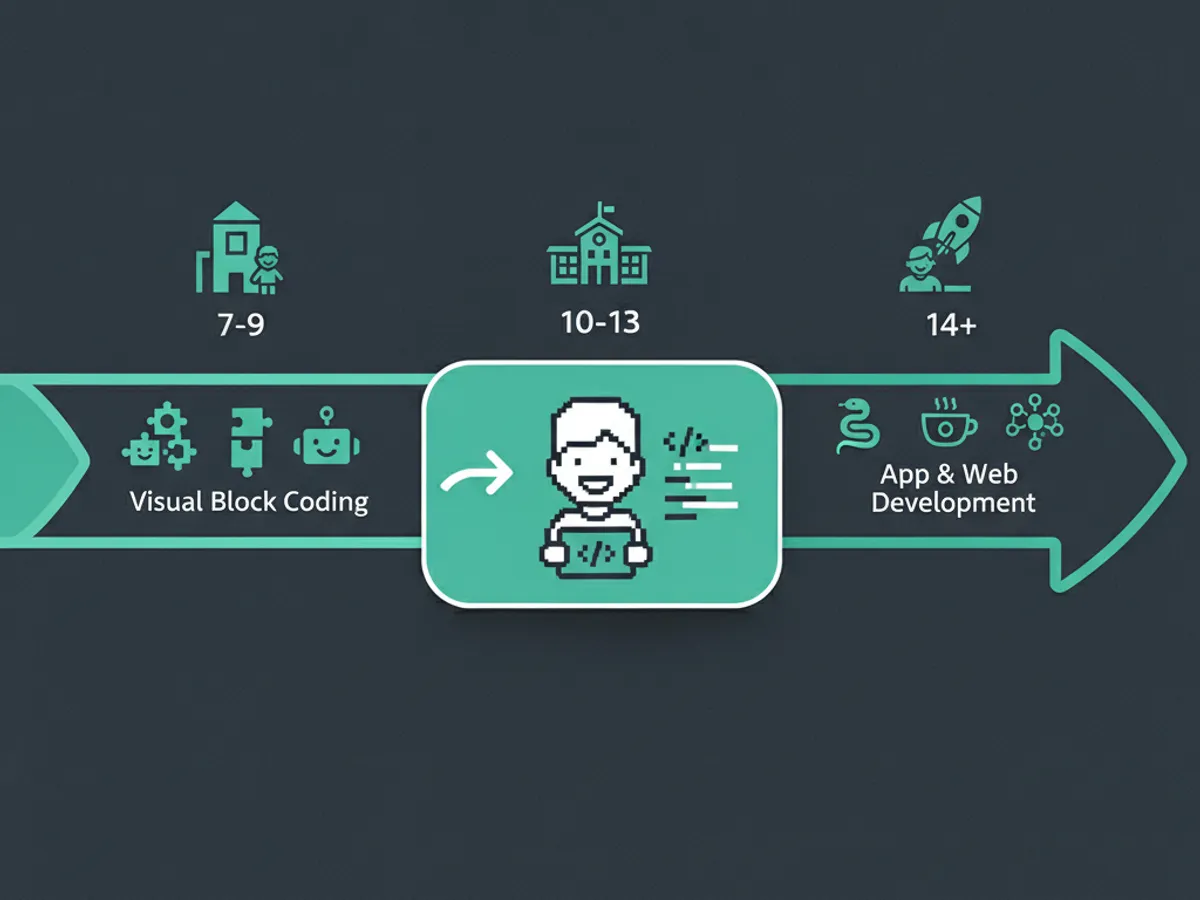
At 12, the question is no longer whether a child can handle text-based code — they can. The question is sequencing. Here is how the main options compare.
| Language | Best For | Difficulty at Age 12 | Portfolio Project |
|---|---|---|---|
| Python | AI, data, games, automation | Easy | Quiz app or data chart |
| JavaScript | Interactive sites and browser games | Medium | Browser game |
| HTML/CSS | Real websites and design | Easy | Personal portfolio site |
| SQL (bonus) | Working with real data | Easy | Stats tracker |
The recommended sequence: Python first for logic, HTML/CSS alongside it for the joy of publishing something real, and JavaScript by month two or three for interactivity. Twelve-year-olds can also begin touching real developer tools — a proper code editor, project version history, and browser developer tools all become appropriate at this age.
What to avoid: professional-grade languages like Java or C++ as a first step (too much boilerplate), and unstructured video-tutorial hopping (lots of watching, little building). The pattern that works is a guided curriculum where every lesson ends in a working, publishable project.
A coding subscription gift covers the full sequence in one account, so there is no platform-hopping as the child levels up.
AI assistance changes the equation at 12. A safe, guided AI tutor means a stuck 12-year-old gets a clear explanation in seconds instead of quitting in frustration. The critical distinction is scaffolding versus substitution: the AI should explain errors and suggest fixes while the child writes the code. Tools where the AI writes the code produce impressive demos and empty skills — parents should check which kind of AI a platform offers before subscribing.
What a 12-Year-Old Can Build, Month by Month
Assuming three sessions a week of 30-45 minutes, here is a realistic build trajectory for a 12-year-old starting from zero.
| Month | Project | Skills Demonstrated |
|---|---|---|
| 1 | Personal homepage in HTML/CSS | Structure, styling, publishing |
| 2 | Interactive JavaScript game | Variables, events, conditionals |
| 3 | Python quiz or text adventure app | Functions, loops, data handling |
| 4-5 | Multi-page portfolio site | Planning, navigation, design |
| 6 | Original game or AI-assisted app | Full project cycle, debugging |
A note on what counts as finished: a project is done when someone else can use it without the child in the room. That standard — a real user, a working link, no explanation required — is what separates portfolio pieces from classwork. Twelve-year-olds rise to this bar quickly once it is clearly set.
The most important transition happens around month three: the child stops being a tutorial-follower and becomes a project-builder. That shift only happens if projects get published. When a 12-year-old ships work to the shared projects gallery, friends can play it, family can share it, and the child gets the social reward that keeps momentum alive.
A practical rhythm: one finished project per month, each with two sentences of reflection about what was learned. By the end of 7th grade, that is a body of work — not a claim, but clickable proof.
Parents sometimes worry that a later start means a permanent disadvantage. The portfolio logic argues otherwise: because admissions readers weigh trajectory, a child who starts at 12 and ships consistently for three years presents a stronger growth story than a child who started at 8 and plateaued. The curve matters more than the starting point.
How Coding Helps With School Applications and Portfolios
Here is where age 12 pays off years later. NAIS admissions data shows 73 percent of independent school admissions officers value demonstrated coding or technical skills in applicants. NACAC research on college admissions finds 67 percent of colleges give meaningful weight to portfolios and demonstrated skills beyond grades.
Why does a portfolio beat a grade on an application? Three reasons:
- •It is verifiable. Anyone can click a link and play the game the child built.
- •It shows trajectory. A portfolio spanning ages 12 to 16 demonstrates persistence that no transcript can capture.
- •It is rare. Most applicants say they like technology; very few can show four years of shipped work.
"We are not looking for prodigies — we are looking for evidence of sustained curiosity," says one admissions director at a NAIS member school. A portfolio that grows month after month is exactly that evidence.
How should a 12-year-old present the work? Keep it simple: one page, links to the best three to five projects, and one sentence each about what was built and what was learned. Admissions readers spend minutes, not hours, on supplemental material. A middle school student with a clean, working portfolio page stands out precisely because so few applicants have one.
A verifiable coding certificate adds a second layer of proof: an objective, third-party signal that the child completed a structured curriculum. The strongest applications pair the two — the certificate shows rigor, the portfolio shows creativity.
The habit to build at 12 is simple: finish one project a month, publish it, and write a short reflection. By 9th grade, that is more than 30 projects — a body of work most college applicants cannot match.
A 4-Week Starter Plan and Honest Pricing
The 4-week starter plan for a 12-year-old:
- •Week 1 — Setup and foundations. First Python programs: variables, input, output. Goal: a program that holds a conversation with the user.
- •Week 2 — Logic and loops. Conditionals, loops, and lists. Goal: a working game with a score.
- •Week 3 — Personal project. The child chooses: a website, a game, or a quiz app. Goal: a working draft with one feature they designed themselves.
- •Week 4 — Publish and reflect. Ship the project to the shared projects gallery and write two sentences about what was learned. Goal: the first entry in a portfolio that grows for years.
If motivation dips, try these before giving up:
- •Switch the project topic to something the child already loves — a favorite game, sport, or show.
- •Shorten sessions to 20 minutes for two weeks; consistency beats intensity at this age.
- •Show the child other kids' published work in the shared projects gallery — peer examples reset expectations better than adult encouragement.
- •Let the child teach a parent or sibling one thing they have built. Teaching is the strongest retention tool available.
Screen time. At 12, the concern is less about coding and more about what surrounds it. Common Sense Media screen time research consistently ranks creative, skill-building screen use far above passive consumption. Keep coding sessions to 30-45 minutes, agree on device-free times as a family, and let the portfolio — not the clock — be the measure of progress. One practical rule many families adopt: coding sessions happen before entertainment screen time, not after. A 12-year-old who builds for 40 minutes before recreational screen use treats coding as a privilege rather than a chore — and the portfolio keeps growing regardless of how the rest of the screen-time budget gets spent.
Pricing. Parents often ask: what are the pricing options for coding camps available this summer, and how do platforms compare? Here is the 2026 picture:
| Learning Option | Typical Cost | Structure | Portfolio | Certificate |
|---|---|---|---|---|
| KidsCode Gift (annual) | $99.99/year | Full curriculum + AI tutor | Yes | Yes |
| KidsCode Gift (monthly) | $9.99/month | Same | Yes | Yes |
| Coding camp (summer) | $300-$1,500 per week | 1-2 weeks | Rarely | Sometimes |
| Private tutor | $40-$100 per hour | Custom | No | No |
| School elective | Free | One semester | No | No |
Camps are excellent for a concentrated burst, but they end — and the skills fade without continued practice. Tutors remain the premium option and make sense for targeted help — a specific competition or a stuck concept — but at hourly rates they cannot carry a full curriculum economically. A year-round platform keeps the portfolio growing through the school year for less than the cost of one camp week. Compare plans on the pricing page, or browse gift packs for birthday and holiday bundles.
Frequently Asked Questions
What is the best coding language for a 12-year-old?
Is 12 too late to start coding?
Can coding help with school or college applications?
How much time should a 12-year-old spend coding each week?
How much does coding instruction for a 12-year-old cost?
Free: First 10 Coding Projects for Kids (PDF)
A printable starter pack — real projects your child can build this weekend. No spam, unsubscribe anytime.
Start Your Child's Coding Journey Today
Two full courses free. No credit card required. AI-assisted learning for ages 7–16.
Get Started Free