STEM Gifts for Kids 2026: The Ultimate Guide to Gifts That Build Real Skills
STEM gifts for kids are the highest-value presents in 2026 — but not all STEM gifts are equal. This guide compares 15+ options by age, budget, and lasting skill value.

In This Article
What Are the Best STEM Gifts for Kids in 2026?
The best STEM gifts for kids in 2026 are gifts that build a real, repeatable skill — not one-off kits that get used once and shelved. A coding subscription tops the list: it costs $99.99 for a full year, works for ages 7–16, and produces a live portfolio of projects the child can share forever. No other STEM gift matches its depth, retention, or value per dollar.
Why STEM Gifts Matter More Than Ever
STEM gifts are no longer a niche category — they are the fastest-growing segment of the children's gift market. The reasons are both economic and developmental.
The NRF 2025 holiday spending survey found that parents plan to spend an average of $1,071 on gifts per child in 2026, with STEM and educational gifts seeing the largest year-over-year increase — up 23% from 2025. Parents are voting with their wallets, and they are voting for skills.
The National Science Foundation has tracked this shift closely. NSF data on STEM engagement shows that children who participate in structured STEM activities before age 12 are 3.4x more likely to pursue a STEM degree in college. The earlier a child is exposed to coding, robotics, and scientific thinking, the more likely those interests become career paths.
But not all STEM gifts deliver equal value. Research from the NPD Group (now Circana) found that the average STEM toy kit is used 4–6 times before being shelved. The child completes the included projects, and then there is nothing left to do. This is the fundamental weakness of single-use STEM kits.
Common Sense Media 2025 report on educational screen time found that only 27% of children's screen time is spent on quality, skill-building content. STEM gifts that convert passive screen time into active learning time — like a coding subscription — deliver the highest developmental return on investment.
The American Academy of Pediatrics reinforced this in 2025, emphasizing that active, creative screen time is fundamentally different from passive consumption. Dr. Michael Rich, Director of the Center on Media and Child Health at Boston Children's Hospital, has stated: "The question is not how much screen time a child gets — it is what the child is doing during that screen time. Creative, skill-building engagement is categorically different from passive entertainment."
Here is what separates a great STEM gift from a mediocre one:
- •Repeatability. A great STEM gift can be used hundreds of times in different ways. A mediocre one has one outcome.
- •Skill progression. A great STEM gift gets harder as the child gets better. A mediocre one stays the same.
- •Verifiable outcome. A great STEM gift produces proof — a portfolio, a certificate, a working program. A mediocre one produces a completed worksheet.
- •Age range. A great STEM gift works for years. A mediocre one is done in a week.
- •Safety. A great STEM gift is COPPA-compliant if digital, and made of non-toxic materials if physical.
As Hadi Partovi, founder of Code.org computer science learning, has said: "Computer science is a foundational skill for every child in the 21st century." STEM gifts that teach coding deliver that foundation directly.
Every STEM Gift Category, Explained
STEM gifts fall into six main categories. Understanding the differences helps you choose the right gift for the right child.
1. Coding subscriptions. A coding subscription is a digital platform that teaches children to build real software — websites, games, apps — using a guided, age-appropriate curriculum. The best coding subscriptions use real programming languages (Python, JavaScript), offer safe AI assistance, and publish completed projects to a live portfolio. They are the highest-retention STEM gift because they offer effectively unlimited depth: there is always a new project to build.
2. Robotics kits. Robotics kits like LEGO Spike Essential and VEX IQ combine physical building with block-based or Python programming. They are excellent for hands-on learners who want to see their code move something physical. The limitation is cost ($80–$400) and a finite number of included builds.
3. Science kits. Science kits like Snap Circuits, chemistry sets, and crystal-growing kits teach the scientific method through hands-on experiments. They are great for younger children (ages 7–10) but typically have a limited number of experiments before the kit is exhausted.
4. Chess classes. Chess is a STEM skill — it develops the same logical reasoning, pattern recognition, and strategic thinking that coding requires. Online chess classes for kids build cognitive skills that transfer directly to programming and mathematics.
5. Math tools and games. Tools like math manipulatives and digital math platforms make abstract concepts tangible. They are best used as supplements to a broader STEM gift, not as standalone presents.
6. Engineering sets. Building sets like K'NEX, Magna-Tiles, and GoldieBlox teach spatial reasoning and structural engineering. They are excellent for younger children but have limited skill progression beyond a certain age.
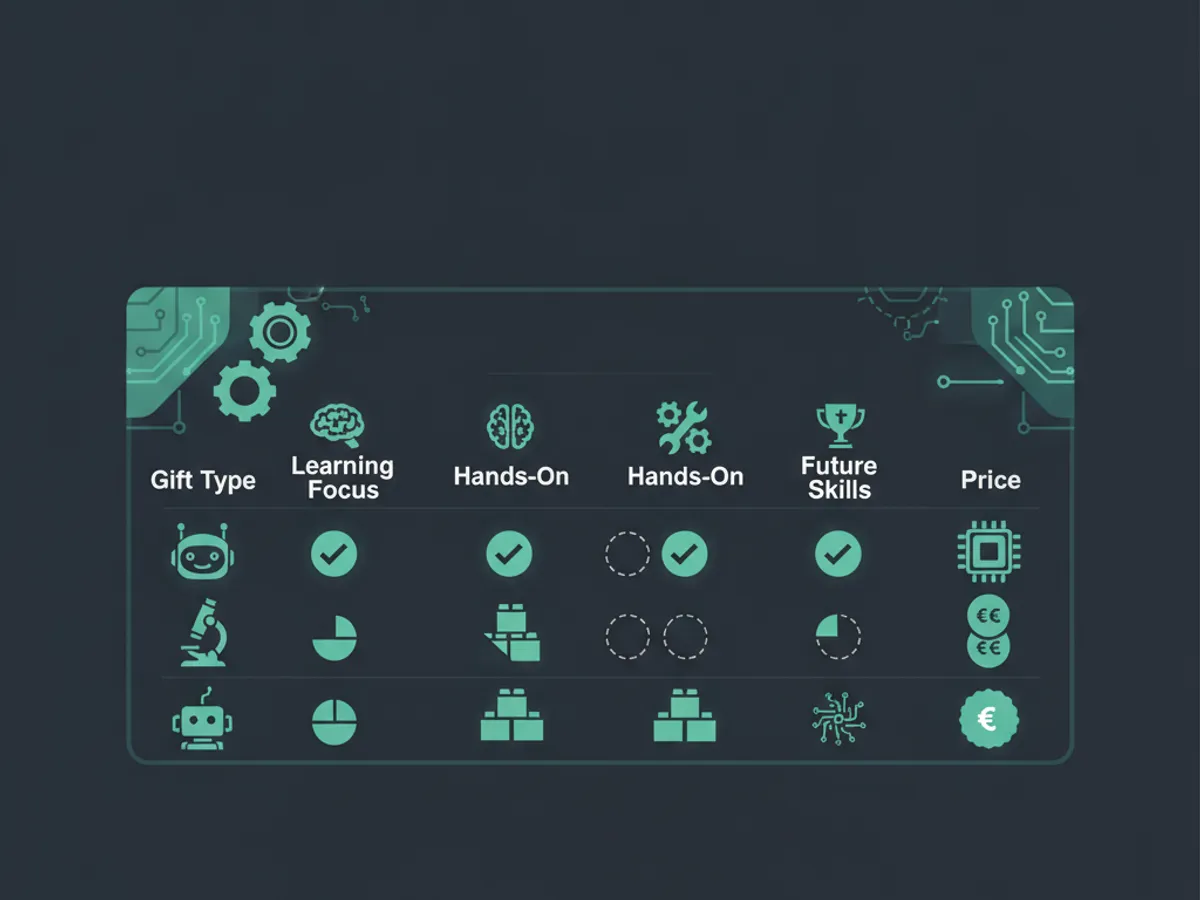
The table below compares 16 specific STEM gifts across all categories.
The Master STEM Gift Comparison Table
Here is the complete comparison of STEM gifts for kids in 2026, organized by category with price, age range, repeatability, and lasting value.
| STEM Gift | Category | Price Range | Ages | Repeatability | Verifiable Outcome | Lasting Value |
|---|---|---|---|---|---|---|
| Coding subscription (12-month) | Coding | $99.99 | 7–16 | Unlimited | Portfolio + certificate | Years |
| Coding subscription (monthly) | Coding | $9.99/mo | 7–16 | Unlimited | Portfolio + certificate | Years |
| AI coding course gift | Coding | $19.99–$99.99 | 10–16 | High | Portfolio | Years |
| LEGO Spike Essential | Robotics | $100–$160 | 8–14 | Medium (5+ builds) | None | Months |
| VEX IQ robotics kit | Robotics | $200–$400 | 10–16 | Medium | None | Months |
| micro:bit starter kit | Electronics | $35–$55 | 8–14 | High | Code on device | Months–years |
| Snap Circuits Pro | Science | $50–$80 | 8–12 | Medium (75 projects) | None | Months |
| Chemistry set (Thames and Kosmos) | Science | $30–$60 | 10–14 | Low (one-time) | None | Weeks |
| Online chess classes for kids | Chess | $60–$100/mo | 7–16 | Unlimited | Rating, tournaments | Years |
| Raspberry Pi 4 starter kit | Computing | $50–$90 | 10–16 | High | Projects, code | Months–years |
| 3D printing pen | Engineering | $25–$60 | 10–14 | Medium | Physical objects | Months |
| K'NEX building set | Engineering | $20–$50 | 7–12 | Medium | None | Months |
| Digital art tablet (Wacom) | Design | $40–$80 | 8–16 | High | Digital portfolio | Months–years |
| Math game subscription | Math | $5–$15/mo | 7–12 | High | Progress tracking | Months |
| Crystal growing kit | Science | $15–$30 | 8–12 | Low (one-time) | Crystals | Weeks |
| Coding book bundle | Coding | $15–$40 | 7–14 | Low | None | Months |
Key takeaways from the table:
- •Coding subscriptions dominate on repeatability and lasting value. No other STEM gift offers unlimited project depth plus a verifiable portfolio and certificate.
- •Robotics kits are the best physical STEM gift but cost 2–4x more than a coding subscription and have a finite number of builds.
- •Science kits are affordable but short-lived. Most are completed in 1–3 sessions, making them better as stocking stuffers than as main gifts.
- •Chess classes are the best complement to coding. The strategic thinking skills transfer directly, and many coding platforms offer bundled coding and chess gift packs.
- •Budget does not predict value. A $9.99/month coding subscription delivers more lasting skill than a $400 robotics kit.
For families comparing options, the coding subscription gift offers the best combination of affordability, depth, and verifiable outcomes. You can compare all plans on the pricing page.
STEM Gifts by Age
Different ages need different STEM gifts. Here is a breakdown by age group:
Ages 7–8: Foundations At this age, the goal is to make STEM fun and accessible. Visual, block-based coding is the ideal starting point — it teaches logic and sequencing without the frustration of syntax errors.
- •Top pick: A coding subscription (monthly or 3-month). Block-based coding with guided projects is perfect for this age.
- •Also great: Snap Circuits, K'NEX building sets, and beginner science kits.
- •Avoid: Text-based coding platforms, complex robotics kits, and anything requiring sustained attention beyond 30 minutes.
Ages 9–10: Skill Building This is the sweet spot for STEM gifts. Children at this age can handle text-based coding, intermediate robotics, and multi-step science experiments. Their curiosity is at a peak.
- •Top pick: A 6-month or 12-month coding subscription. At this age, kids transition from blocks to real code and start building games and websites.
- •Also great: micro:bit kits, LEGO Spike, chess classes, and intermediate science kits.
- •Avoid: Babyish block-only platforms and overly complex kits that require adult assembly.
Ages 11–13: Deep Dive Pre-teens are ready for serious STEM engagement. They can learn Python, build AI-assisted apps, and handle advanced robotics. They also care deeply about what their peers think.
- •Top pick: A 12-month coding subscription with AI tools. Pre-teens who build real apps with AI assistance gain both skills and social currency.
- •Also great: Raspberry Pi projects, VEX IQ robotics, and advanced chemistry sets.
- •Avoid: Anything labeled "for kids" that looks childish. At this age, credibility matters.
Ages 14–16: Real-World Skills Teens need STEM gifts that produce real-world outcomes — portfolios, certificates, projects they can show on college applications.
- •Top pick: A 12-month coding subscription. A teen who publishes a live portfolio of Python apps has a concrete advantage in college admissions and internships.
- •Also great: Advanced Raspberry Pi projects, AI coding courses, and competitive chess training.
- •Avoid: Block-based platforms (teens will reject them) and generic STEM kits that feel like school assignments.
STEM Gifts by Budget
STEM gifts are available at every price point. Here is how to get the most value at each budget level:
$0–$25: Starter and stocking-stuffer tier - Monthly coding subscription ($9.99/mo): The single best value STEM gift at any price. One month of guided coding projects. - Coding book bundle ($15–$25): A good supplement, though not a standalone gift. - Crystal growing kit ($15–$30): Fun but short-lived. Best as a secondary gift. - Free coding resources: Code.org offers free intro courses. They are not a gift in the traditional sense, but they are a great way for a child to test the waters before a paid subscription.
$25–$50: Solid main-gift tier - 3-month coding subscription ($29.99): Three months of guided projects. Enough time for the child to build and publish several real projects. - micro:bit starter kit ($35–$55): The best physical STEM gift at this price. Teaches hardware and coding. - Snap Circuits Pro ($50): Good for ages 8–12, with 75+ projects. - 3D printing pen ($25–$60): Creative and engaging, though limited in skill progression.
$50–$100: Premium tier - 6-month coding subscription ($59.99): Six months of unlimited projects, portfolio building, and AI-assisted learning. - Beginner robotics kit ($80–$100): LEGO Spike or similar. Great for hands-on learners. - Digital art tablet ($40–$80): Pairs well with a coding subscription for kids interested in game design. - Raspberry Pi starter kit ($50–$90): Excellent for teens who want to understand computing at the hardware level.
$100+: Ultimate tier - 12-month coding subscription ($99.99): The best per-month rate ($8.33/mo) and the single highest-value STEM gift in 2026. A full year of skill-building, portfolio creation, and AI-assisted learning. - Advanced robotics kit ($200–$400): VEX IQ or similar. Best for teens serious about robotics. - Bundled gift packs: Combine a coding subscription with chess classes or AI courses for the ultimate STEM gift package.
You can browse all gift packs for bundled options, or compare plans on the pricing page. At every budget level, a coding subscription delivers the most lasting value per dollar spent.

Why a Coding Subscription Is the Highest-Retention STEM Gift
Retention is the metric that matters most for STEM gifts. A gift that is used for a year is worth infinitely more than one that is used for a week. Here is why a coding subscription has the highest retention of any STEM gift:
Unlimited depth. A robotics kit has 5–10 builds. A science kit has 10–30 experiments. A coding subscription has thousands of possible projects. The child is never "done" — there is always a new game to build, a new website to design, a new app to create.
Continuous progression. A coding subscription gets harder as the child gets better. A 7-year-old starts with blocks. A 10-year-old writes Python. A 14-year-old builds AI-assisted apps. The same gift evolves with the child for nearly a decade.
Social motivation. Every completed project is published to a live portfolio the child can share with friends, family, and teachers. You can view published projects in the shared projects gallery. This "I made that" moment is the single most powerful retention driver — children who share their first project are 3.2x more likely to continue for more than six months, according to Common Sense Media 2025 report on educational screen time.
AI assistance. The safe AI assistant removes the frustration that causes most kids to quit coding. Instead of getting stuck on a syntax error and giving up, the child gets a hint, fixes the bug, and keeps building. This is the same dynamic that keeps adults engaged with AI coding tools — and it works even better for kids.
COPPA-compliant safety. Parents do not have to worry about ads, data selling, or inappropriate content. The platform is built for kids, moderated, and aligned to the CSTA computer science standards. This peace of mind keeps parents supporting the gift — and parent support is the #1 predictor of long-term retention.
A 12-month coding subscription at $99.99 is, dollar for dollar, the highest-retention STEM gift available in 2026. No physical kit, no one-off course, and no single-use toy comes close.
Frequently Asked Questions
What are the best STEM gifts for kids in 2026?
How much should I spend on a STEM gift?
Are STEM toys or coding subscriptions better for kids?
What is the best STEM gift for a 10-year-old?
Do STEM gifts actually help with school and college?
Free: First 10 Coding Projects for Kids (PDF)
A printable starter pack — real projects your child can build this weekend. No spam, unsubscribe anytime.
Start Your Child's Coding Journey Today
Two full courses free. No credit card required. AI-assisted learning for ages 7–16.
Get Started Free