Educational Gifts That Aren't Toys: 15 Ideas That Build Real Skills in 2026
Parents are tired of toys that get abandoned in 30 days. These 15 non-toy educational gifts build lasting skills across price points from $0 to $500 — and a coding subscription is the #1 pick.

In This Article
What Are Educational Gifts That Aren't Toys?
The best educational gifts that aren't toys build lasting skills instead of clutter. A 2025 NRF study found that 63% of parents now prefer experience gifts over physical toys. Top picks include a coding subscription, online chess classes, language courses, and project portfolios — gifts that keep giving long after the box is opened.
Non-toy educational gifts are experiences, subscriptions, and digital tools that teach a child a repeatable skill. Unlike a plastic toy that loses novelty in weeks, a skill-building gift compounds in value every time the child uses it.
Why Non-Toy Gifts Outperform Traditional Toys
The case against toys is backed by data, not just parental frustration. The NPD Group study on toy abandonment found that the average child loses interest in a new toy within 36 days, and roughly 70% of toys received as gifts are no longer played with after three months. That is a lot of plastic and a lot of wasted money.
Meanwhile, the shift toward experience gifts is accelerating. The NRF 2025 Consumer Holiday Survey reported that 63% of parents would prefer to give their child an experience or skill-building gift rather than a physical toy, up from 48% just two years prior. Parents are voting with their wallets.
The quality of screen time matters more than the quantity. Common Sense Media's 2025 report on media use found that children ages 8–12 spend an average of 5.5 hours per day on screens, but only 27% of that time is spent on "quality" content — activities that build a skill, create something, or teach a concept. The right non-toy gift converts passive screen time into active learning time.
Here is why non-toy educational gifts win on every measurable axis:
- •Retention: A skill, once learned, cannot be outgrown or broken. A toy can.
- •Compounding value: Each session with a coding subscription or chess class builds on the last. A toy is static.
- •Confidence: Completing a real project or winning a real game builds genuine self-efficacy. Pressing a button on a plastic toy does not.
- •Space: Experience gifts take up zero shelf space — a relief for parents already drowning in clutter.
- •Long-term outcomes: The CSTA computer science standards explicitly note that sustained, project-based learning over months produces dramatically better outcomes than one-off activities.
As Dr. Jenny Radesky, a developmental pediatrician and member of the American Academy of Pediatrics, has noted: "Open-ended, creative, and skill-building activities consistently outperform passive entertainment when it comes to healthy child development." That is the core argument for non-toy gifts.
15 Educational Gifts That Aren't Toys in 2026
Below is a catalog of 15 non-toy educational gifts, organized by price point. Each one builds a real, repeatable skill. The coding subscription gift is positioned as the #1 pick because it combines low cost, high retention, and a verifiable outcome (a portfolio of real projects).
| # | Gift | Price Range | Ages | Skill Built | Lasting Value |
|---|---|---|---|---|---|
| 1 | Coding subscription gift | $9.99–$19.99/mo | 7–16 | Programming, AI literacy, portfolio | Very High |
| 2 | Online chess classes | $15–$25/session | 7–16 | Strategy, focus, spatial reasoning | High |
| 3 | Language learning subscription | $5–$15/mo | 7–16 | Bilingualism, cultural awareness | High |
| 4 | Digital art & design course | $20–$50 | 8–16 | Visual creativity, tool fluency | Medium |
| 5 | Music lessons (online) | $25–$50/session | 7–16 | Discipline, performance, theory | High |
| 6 | Robotics kit (no toy — a tool) | $50–$150 | 9–16 | Engineering, circuits, coding | High |
| 7 | 3D printing course + printer access | $100–$300 | 10–16 | CAD, design thinking | Medium |
| 8 | Book series (coding, science) | $15–$60 | 7–16 | Reading, domain knowledge | Medium |
| 9 | Science experiment subscription box | $25–$40/mo | 7–12 | Hands-on inquiry | Medium |
| 10 | Typing & keyboarding course | $10–$30 | 7–12 | Speed, accuracy, ergonomics | High |
| 11 | Video editing course | $20–$80 | 10–16 | Storytelling, media literacy | Medium |
| 12 | Math olympiad / competition prep | $15–$50/mo | 8–16 | Problem-solving, logic | High |
| 13 | Astronomy & space science kit | $30–$120 | 8–14 | Observation, curiosity | Medium |
| 14 | Entrepreneurship / business camp | $100–$500 | 12–16 | Finance, pitching, leadership | High |
| 15 | Museum / science center membership | $50–$200/yr | All | Broad exposure, family bonding | Medium |
The $0–$50 tier (gifts 1, 3, 4, 8, 10): These are the highest-value-per-dollar options. A coding subscription gift at $9.99/month delivers unlimited courses, a verifiable certificate, and a live portfolio — more skill-building than any $50 toy on the shelf.
The $50–$150 tier (gifts 2, 5, 6, 9, 11, 12, 13): These are structured experiences with a human or guided component. Online chess classes for kids, for example, pair a child with an instructor who adapts to their level — something no toy can do.
The $150–$500 tier (gifts 7, 14, 15): These are premium, often multi-month experiences. They make excellent group gifts (grandparents chipping in together) and tend to produce the most memorable outcomes.
The #1 Pick: A Coding Subscription Gift
Of all 15 gifts above, the coding subscription gift is the clear #1 pick for 2026. Here is why it beats every other option on the list:
- •It produces a verifiable outcome. A child who completes a coding subscription has a live portfolio of real websites, games, and apps — proof of skill that can be shared with family, teachers, and eventually college admissions officers. You can browse the shared projects gallery to see exactly what kids build.
- •It scales with the child. A 7-year-old starts with block-based logic; a 16-year-old builds Python apps with AI assistance. The same gift grows with the child for years.
- •It is COPPA-compliant and safe. Unlike random YouTube tutorials, a vetted platform with a safe AI assistant means parents do not have to hover.
- •It is the most affordable high-impact gift. At $9.99/month, a full year costs less than a single video game console and produces a portfolio instead of a high score.
- •It aligns with recognized standards. Quality platforms align their curriculum to the CSTA computer science standards, so the learning maps to what schools and employers actually expect.
You can explore gift packs that bundle multiple months, or visit the pricing page to see exactly what is included. The recipient redeems the gift with a simple code — no shipping, no wrapping paper, no waste.
As Hadi Partovi, founder of Code.org computer science learning, has stated: "Every child in every school should have the opportunity to learn computer science." A coding subscription gift is the most direct way to give a child that opportunity outside of school.
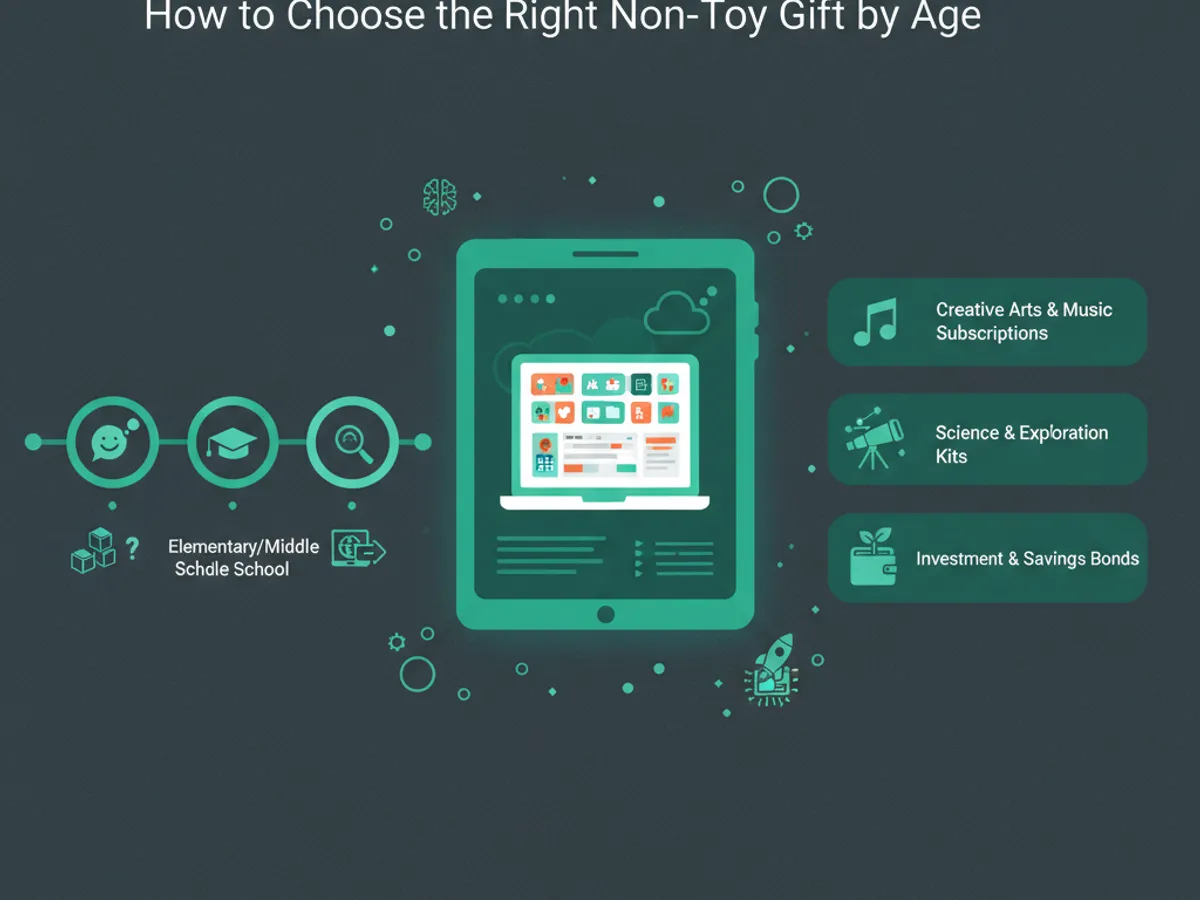
How to Choose the Right Non-Toy Gift by Age
Not every non-toy gift fits every child. Here is a quick guide to matching the gift to the age and temperament of the recipient:
Ages 7–9: Focus on visual, immediate-feedback gifts. A coding subscription with block-based projects, online chess classes, or a science experiment box are ideal. The child should see a result within the first session.
Ages 10–12: Introduce text-based coding (Python, JavaScript), language subscriptions, and robotics kits. This is the age where kids begin to self-identify as "good at" something — give them a gift that lets them test that identity.
Ages 13–16: Teens want real tools, not toys. A coding subscription that builds a portfolio, a coding certificate for college apps, or an entrepreneurship camp all signal that you respect their maturity. Avoid anything that feels "babyish."
The temperament test: Ask yourself — does this child like to build, compete, perform, or explore?
- •Builders thrive with coding subscriptions, robotics, and 3D design.
- •Competitors thrive with chess classes, math olympiad prep, and coding competitions.
- •Performers thrive with music lessons and video editing.
- •Explorers thrive with language subscriptions, astronomy kits, and museum memberships.
The beauty of non-toy gifts is that they reveal a child's temperament over time — something a single toy can never do.
Making Experience Gifts Feel Like "Real" Presents
The most common objection to non-toy gifts is that they do not feel "real" on the day. A child tearing wrapping paper expects a physical object. Here is how to make an experience gift feel just as exciting:
- •Print a custom gift certificate. A nicely designed certificate with the child's name, the gift, and a QR code to redeem it feels tangible and personal.
- •Pair it with a small physical token. A chess class gift paired with a real chess piece, or a coding subscription paired with a cheap mechanical keyboard, bridges the physical-digital gap.
- •Make the reveal an event. Record a video message from the gift-giver, or set up a "treasure hunt" that ends with the redemption code.
- •Schedule the first session together. The first 30 minutes of a coding subscription or chess class, done side-by-side with a parent, dramatically increases the chance the child sticks with it.
- •Celebrate the first output. When the child builds their first website or wins their first chess game, treat it like a birthday — print it, frame it, share it with grandparents.
The goal is to signal that an experience gift is not a "lesser" gift. It is, in fact, the more serious and more generous one — because you are investing in the child's future, not their next 30 days.
A Common Sense Media 2025 report on family media habits found that children whose parents actively participate in their first digital-learning sessions are 2.3 times more likely to continue the activity for more than three months. Your involvement on day one is the single biggest predictor of whether the gift "sticks."
That is the real secret of educational gifts that aren't toys: they require a small amount of parental participation up front, and they pay dividends for years.
Frequently Asked Questions
What are the best educational gifts that aren't toys?
Are experience gifts better than toys for kids?
How much should I spend on a non-toy educational gift?
What is the best non-toy gift for a child who already has everything?
Can a coding subscription really replace a physical toy?
Free: First 10 Coding Projects for Kids (PDF)
A printable starter pack — real projects your child can build this weekend. No spam, unsubscribe anytime.
Start Your Child's Coding Journey Today
Two full courses free. No credit card required. AI-assisted learning for ages 7–16.
Get Started Free